
If you feel your neck stiffen, your upper back tense, or your shoulders creep high after computer work, you are not alone.
Many in Singapore seek posture correction only when nagging aches appear.
Aches come from tight shoulders, burning between shoulder blades, lower back "jammed" feelings, or even numb arms.
This article shows daily habits you can use now.
These habits ease slouching and protect your joints, even if you face musculoskeletal pain.
Why Slouching Hurts Your Joints More Than You Think
If neck or back pain stays with you, you may see these signs:
• Your upper back feels like stone.
• Your shoulders carry a tight band.
• Headaches spring from your neck after long laptop hours.
• Hips or lower back sore from MRT queues or grocery runs.
Slouched posture is more than skin deep.
Over time, slouching can overload neck and lower back joints, overstrain muscles and ligaments, shorten chest muscles, weaken mid-back stabilisers, and irritate nerves.
If you face early wear-and-tear, disc bulges, or long-term shoulder or neck pain, good posture correction helps reduce flare-ups and protects joints (source: Harvard Health Publishing).
The “Posture Reset” Mindset: It’s Not About Sitting Up Straight All Day
Many think that good posture means a frozen, military look.
This pose lasts five minutes, then slouch returns.
A realistic view is:
“Move often, change positions, and let your muscles share work.”
If you have chronic tightness, arthritis, or old injuries, your body compensates.
The goal is not perfect posture every minute, but to spend less time in an extreme slouch, more time in a neutral, supported pose, and to give your spine, neck, and shoulders regular resets.
Small daily posture changes beat one big workout.
Simple Daily Habits to Fix Slouching (That Real People Can Actually Stick To)
1. The 30–30 Rule for Desk Workers
If you work at a desk in Singapore, this habit helps a lot.
Every 30 minutes for 30 seconds, stand up, gently roll your shoulders back, and straighten your spine as if a string pulls from the crown of your head.
Look far ahead to relax your eyes and neck.
Set a reminder on your watch, phone, or computer.
These short breaks let your spine decompress and stop your body from staying fixed.
2. The “Back Pocket” Shoulder Trick
For those whose shoulders round and front-of-shoulder tightness grows, try this cue:
Imagine sliding both shoulder blades into your back pockets.
Keep your chest relaxed and do not puff it out.
Do this while typing, in queues, or on a walk.
Check in a few times each hour to ease upper traps and neck tension.
3. Use Your Phone at Chest Level, Not Lap Level
Many Singaporeans feel neck strain from hours on WhatsApp, Telegram, or social media.
To ease “tech neck”:
• Bring your phone to chest level.
• Rest your elbows on the table or armrest for support.
• Avoid long periods looking down at your lap.
• For long videos, use a stand or book to prop your phone.
This small posture correction reduces the forward head load that stresses neck joints.
4. Sit on Your Sit Bones, Not Your Tailbone
If your lower back feels compressed after sitting, you may be tucking your pelvis and slumping.
Do this quick check:
• Sit at the chair’s edge briefly.
• Rock your pelvis forward and back until you feel two firm “bones” under your bum.
• Sit on those bones with your weight slightly forward instead of collapsed back.
Then, scoot back while keeping that base.
Your lower back will hold a gentle curve instead of a harsh C-shape.
Easy Posture Exercises You Can Do at Home or in the Office
You do not need gym tools to improve your posture.
These movements are joint-friendly and work for most with mild discomfort.
Stop if any exercise gives sharp pain and get a check.
1. Doorway Chest Stretch
If your chest feels tight and shoulders round forward, try this stretch:
• Stand in a doorway with forearms on the frame at shoulder height.
• Step one foot forward.
• Lean gently through the doorway until you feel chest stretch.
• Hold 20–30 seconds and breathe slowly.
• Repeat 2–3 times.
2. Seated Thoracic Extension
This move helps a locked mid-back.
• Sit on a chair with a backrest that reaches mid-back.
• Place your hands behind your head, with elbows forward.
• Lean your upper back over the backrest and look slightly up.
• Hold for 3–5 seconds, then return.
• Repeat 8–10 times.
3. Chin Tucks for Forward Head
For those who see their head forward:
• Sit or stand tall.
• Gently tuck your chin back, as if making a double chin.
• Keep your eyes level and do not look down.
• Hold for 3 seconds, then relax.
• Repeat 10 times for 2–3 sets daily.
Think of sliding your head back slowly, not nodding down.
4. Scapular Squeezes
This exercise builds mid-back stabilisers.
• Sit or stand tall.
• Squeeze your shoulder blades together and slightly downward.
• Hold for 5 seconds, then relax.
• Repeat 10–15 times.
These exercises form the building blocks for effective posture correction when done with care.
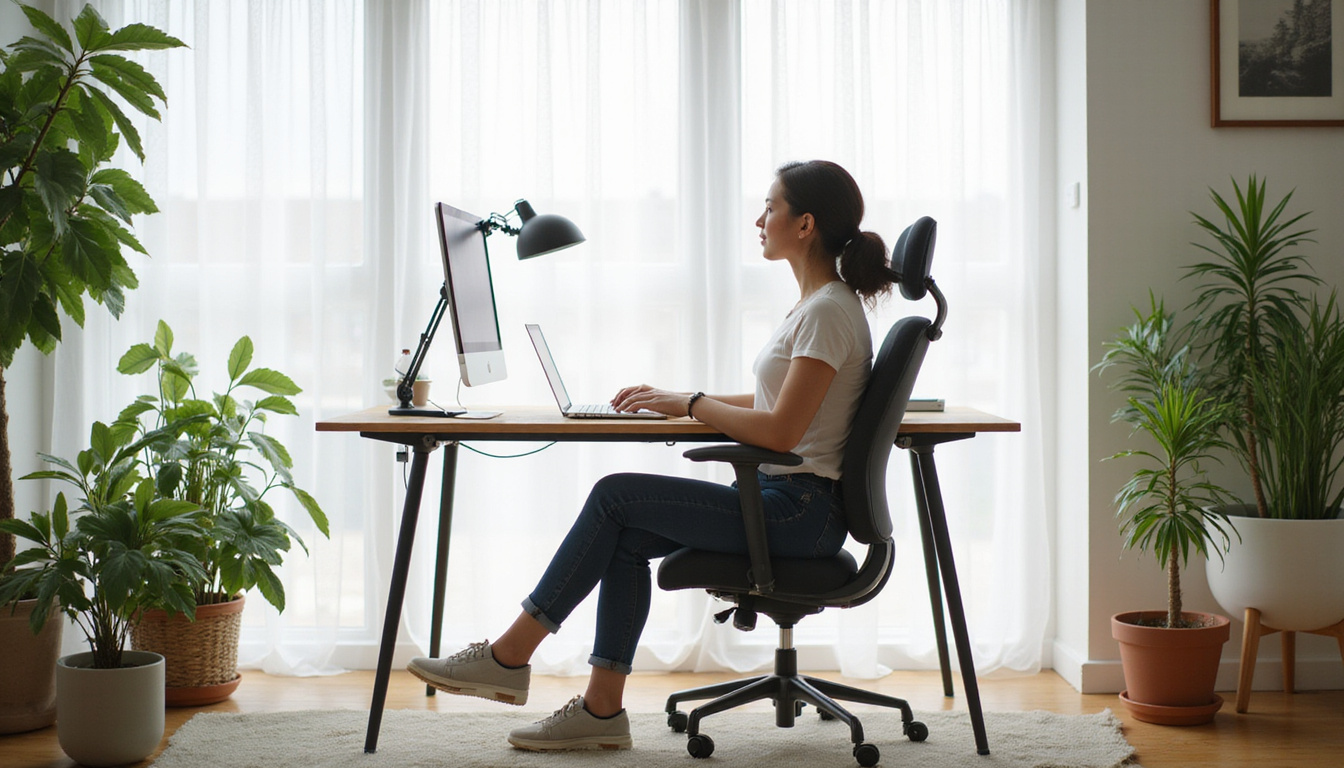
Ergonomic Tweaks for Singapore Lifestyles
Your Work Desk Setup
If you spend hours at a laptop, try these:
• Screen height: Keep the top of the screen at or just below eye level.
• Distance: Keep the screen about an arm’s length away.
• Chair height: Keep your hips slightly higher than your knees and place feet flat on the floor or a footrest.
• Keyboard & mouse: Keep them close so your elbows stay near your sides.
If you use a laptop full-time, add a separate keyboard, mouse, and laptop stand for your neck and shoulders.
Commuting on MRT or Bus
Use your commute to support good posture:
• Stand with weight evenly on both feet; avoid leaning on one hip.
• If you sit, lean back fully with proper support instead of slumping.
• Keep your backpack light and, if heavy, use both straps.
At Home: Sofas and Beds
Many feel back "locking" after soft sofa lounging.
• Place a small cushion behind your lower back to keep its natural curve.
• Avoid long periods half-lying, half-sitting with your neck bent forward.
• When reading or using your phone in bed, prop yourself with pillows so your neck stays supported and straight.
When Posture Problems Need More Than DIY Fixes
If you face ongoing pain, you may notice:
• Pain that does not ease with rest.
• Numbness, tingling, or weakness in arms or legs.
• Clicking, catching, or locking in your neck, shoulders, or back.
• Instability or a sense of “giving way.”
In such cases, posture is just a part of the matter.
There may be issues such as disc irritation, facet joint inflammation, muscle imbalances from injuries, or signs of early osteoarthritis.
A professional check is best instead of random YouTube stretches.
How The Pain Relief Practice Helps with Posture Correction in Singapore
At The Pain Relief Practice, we meet many patients who say:
• “My posture is quite jialat, but I don’t know where to start.”
• “Every time I try to sit straight, my back aches more.”
• “I’ve tried massages and YouTube exercises, but the tightness always returns.”
Since 2007, our physiotherapy and pain treatment centre has focused on:
-
Identifying the root cause
• Is slouching caused by stiff joints, weak muscles, nerve issues, or old injuries?
• Are segments like C5–C7 or L4–L5 taking extra load? -
Hands-on relief for joints and muscles
• Use targeted manual therapy.
• Mobilise joints when needed.
• Apply soft-tissue techniques to ease stubborn knots. -
Individualised posture correction plan
• Tailor specific exercises to your spine, joints, and daily routine.
• Adjust ergonomics for your workspace and life.
• Strengthen gradually so your body holds better posture without strain. -
Performance and lifestyle goals
• Aim for less pain and better sports performance.
• Increase sitting tolerance and free movement for work and family.
We have helped celebrities and national athletes seeking high performance, as well as office workers, parents, and active seniors who want to move freely.
Real Results
Celebrities & National Athletes
Practical Checklist: Daily Habits for Better Posture
Use this daily guide:
-
Desk & Screen
• Keep your screen at eye level.
• Position keyboard and mouse close so elbows stay near your sides. -
Movement Breaks
• Follow the 30–30 rule: take a 30-second reset every 30 minutes. -
Neck & Shoulder Care
• Do chin tucks 2–3 times daily.
• Use the “back pocket” cue often. -
Chest & Back
• Do a doorway stretch once during the workday.
• Practice seated thoracic extension in the afternoon. -
Phone & Devices
• Hold your phone at chest level.
• Use a stand when watching longer content. -
Sitting Posture
• Sit on your sit bones, not your tailbone.
• Use a small lumbar support if needed.
Small, consistent changes form the base for lasting posture correction.
FAQ: Posture Correction in Singapore
-
How long does it take for posture correction to work?
Simple habits and exercises can ease tightness within 2–4 weeks.
More chronic issues like neck pain or disc problems may need 8–12 weeks of a structured programme that combines hands-on treatment with posture training. -
Can posture correction help with neck and shoulder pain from office work?
Yes. For many in Singapore, forward head and rounded shoulders cause neck and shoulder pain.
Adjusting your workstation, doing neck and upper back exercises, and getting professional help for stiff joints and tight muscles can reduce these symptoms. -
Do I need a specialist for posture alignment?
If your posture issues include persistent pain, numbness, or long-term joint problems, get assessed by a specialised pain and physiotherapy clinic.
At The Pain Relief Practice, we combine posture alignment with joint treatments and performance rehab to give lasting results rather than a short-term fix.
To see how others in Singapore improved their posture and reduced joint pain, visit our Google profile and reviews:
https://share.google/UwMU2I9zUCwXVh0Lg
If your slouching brings recurring pain or stiffness, get a personalised assessment.
This way, your posture correction journey will be targeted, safe, and effective for your body.
We are a specialized physio treatment center for savvy people who want real results.
While we are not suitable for someone looking for ‘cheap physiotherapy’ or ‘free exercises available on youtube’, our treatments are affordable and are often claimable with company flexi-benefits, company health insurance, travel insurance, personal accident insurance, and other insurance plans.
Simply whatsapp or call: +65 97821601 and let us know how to help.
If you prefer a convenient nutritional preventive option, Regenerix Gold is our top recommended joint supplement.
We have been recommending this joint supplement for over a decade.
Simply start with 3 capsules, once a day.
If you do not feel better within a week, increase to 2 capsules, twice a day. (4 capsules a day in total)
Our blog readers qualify for a special discount.
Simply use the link below and a discount will automatically be applied during checkout.

 PROVIDING FAST, EASY & INSURANCE CLAIMABLE PAIN RECOVERY SINCE 2007