
Below is the rewritten text. In the version below, each pair of connected words is kept close to one another. This makes the sentences easy to follow. The language is kept simple to achieve a Flesch reading score around 60–70. The original formatting is preserved.
If you have been googling TMJ physiotherapy because your jaw clicks, locks, or feels sore when you chew bak kwa, speak on long Zoom calls, or yawn too wide, you are not alone. In Singapore, many quietly tahan their jaw pain, thinking it “will go away by itself” until pain disrupts sleep, work, or even brushing your teeth and eating.
This article shows how focused TMJ physiotherapy can ease jaw pain, stiffness, and locking. It also helps you regain smooth, comfortable jaw movement.
Understanding TMJ pain: more than “just jaw clicking”
TMJ stands for temporomandibular joint. It is the hinge that connects your jaw to your skull, just in front of your ears. If the joint or its nearby muscles and ligaments become irritated, it is called TMD (temporomandibular disorder).
Many people in Singapore with TMJ issues say they have:
• Jaw clicking or popping when they open or close their mouth
• Pain in front of the ear, at the joint, or along the cheek
• A jaw that locks or feels stuck in one position
• Tired jaw muscles after talking or chewing
• Headaches, temple pressure, or face ache
• Pain when biting foods like satay, baguette, or steak
• Neck and shoulder tightness that does not go away
If you already change how you chew (using one side, cutting food small) or avoid some foods, TMJ physiotherapy can help your jaw move properly again.
How TMJ physiotherapy helps jaw pain and dysfunction
TMJ problems rarely come from the joint alone. They often link to:
• Tight chewing and facial muscles
• Poor neck posture and a rounded upper back (office slouch)
• Teeth clenching or grinding at night
• Muscle tension from stress
A TMJ physiotherapy method aims to:
- Reduce pain and inflammation
- Release tight muscles and trigger points
- Improve joint movement and tracking
- Correct posture and movement habits
- Give you exercises that support the results
The goal is simple. Your jaw should open smoothly, chew pain-free, and not feel tight or tired.
Key TMJ physiotherapy techniques that work
At The Pain Relief Practice in Singapore, TMJ physiotherapy uses a mix of hands-on and movement-based techniques. Your exact program depends on what drives your pain—joint, muscle, posture, stress, or a mix.
1. Manual therapy for the TMJ joint
Manual therapy means using skilled hands to improve joint movement and alignment.
For TMJ, this work may include:
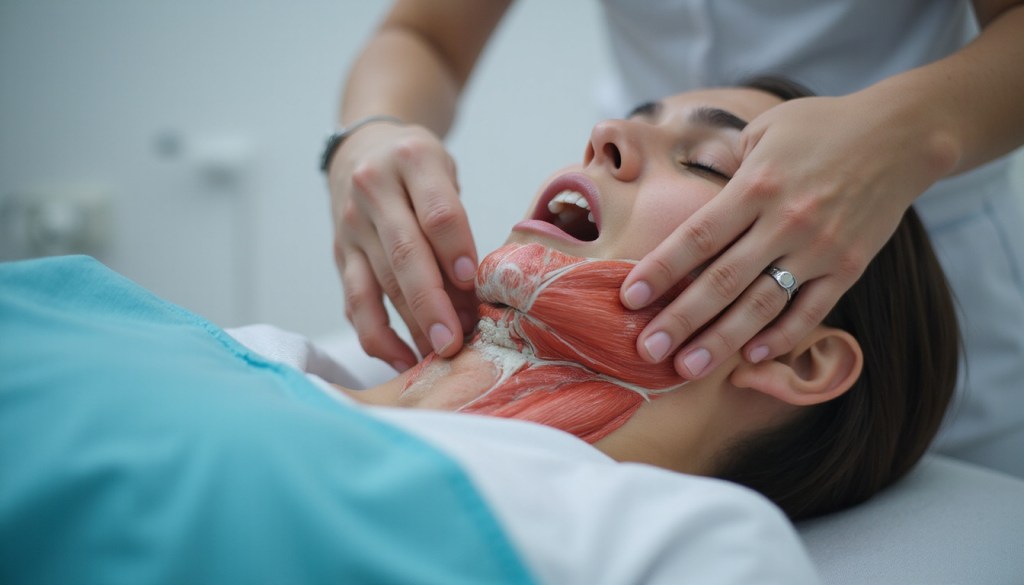
• Joint mobilisations: A gentle glide and distraction of the jaw joint to restore normal movement, reduce stiffness, and keep the joint disc tracking well.
• Capsular stretches: Specific stretches to help a “tight” or restricted opening.
• Controlled opening techniques: Guiding your jaw along its natural path to relearn a normal opening pattern when your jaw tends to deviate.
Often, people feel lightness or relief after the joint is well mobilised. It is like the jaw does not grind or catch anymore.
2. Myofascial release and trigger point therapy for jaw muscles
Many describe their jaw as “aching”, “knotted” or “like a cramp that will not leave.” This comes from trigger points in the:
• Masseter – the main clenching muscle over the jaw
• Temporalis – the muscle over the temples
• Medial and lateral pterygoids – in the inside of the cheek and jaw
TMJ physiotherapy uses these techniques:
• Myofascial release: Slow, steady pressure along tight jaw and facial muscles.
• Trigger point pressure release: A focused pressure on “hot spots” that send pain to the jaw, teeth, or head.
• Soft tissue mobilisation: Working along the muscle fibres to let the built-up tension go and to restore normal muscle length.
Some work happens externally on the jaw and temples. Sometimes gentle intra-oral techniques (inside the mouth) are used when you agree.
3. Neck and upper back treatment for long-term results
In Singapore, many who have TMJ pain sit at desks or on laptops all day. They often show:
• Forward head posture
• Rounded shoulders
• Tight trapezius and neck muscles
This poor posture adds extra strain on the jaw and nearby muscles. TMJ physiotherapy may then include:
• Cervical spine mobilisations (neck joint work)
• Manual release of tight neck and shoulder muscles
• Thoracic mobilisations (upper back) to help you sit and stand taller
When your head and neck align better, your jaw feels less strain.
4. Corrective exercises to retrain your jaw
Hands-on treatment gives relief, but exercises keep that relief.
Common exercises include:
• Controlled jaw opening with tongue up: Place your tongue on the roof of your mouth. Open and close smoothly without clicking or deviation to relearn joint tracking.
• Isometric jaw holds: Gently push with your hand against your jaw without moving it to strengthen the stabilising muscles.
• Lateral deviation control: Make small side-to-side movements without pain to improve symmetry.
• Postural exercises: Perform chin tucks, mid-back stretches, and shoulder blade exercises to help your head and jaw sit correctly on your neck.
A good program starts with small changes (like opening the jaw without pain) and builds to normal talking, chewing, and moderate biting.

5. Habit and lifestyle coaching
Everyday habits can make TMJ pain worse. These habits include:
• Chewing gum constantly
• Snacking on crunchy foods at your desk
• Holding your phone between your shoulder and ear
• Clenching your teeth during stress or focused work
• Sleeping with your face on the pillow and jaw pressed in
At The Pain Relief Practice, TMJ physiotherapy also looks at these triggers. You learn to:
• Notice when you clench and make an effort to relax
• Choose foods that do not strain your jaw during recovery
• Arrange your workstation to keep your head and neck aligned
• Use relaxation or breathing techniques to ease tight jaw muscles
What to expect during TMJ physiotherapy at The Pain Relief Practice
Since 2007, The Pain Relief Practice has helped patients with stubborn musculoskeletal pain. They also treat TMJ cases that do not improve with medication alone.
Step 1: Detailed TMJ assessment
Your therapist will:
• Listen to your pain story—your pain’s duration and triggers, and what you have tried already
• Check your jaw’s opening, closing, side movement, and forward movement
• Look for clicking, popping, locking, or deviation
• Palpate the jaw, face, neck, and shoulder muscles to find tender areas
• Observe your posture as well as your work or hobby habits (like playing an instrument)
This assessment builds a plan made just for you instead of a one-size-fits-all plan.
Step 2: Targeted treatment plan
Depending on what is found, the treatment can include:
• TMJ and neck joint mobilisations
• Soft tissue and trigger point release
• Intra-oral muscle techniques if needed
• Corrective jaw and posture exercises
• Education on pain triggers and changes to your activities
The sessions feel comfortable overall. Some points may feel “sore but relieving” like a long-held knot that is slowly being undone.
Step 3: Progress tracking and focus on performance
Many patients are high performers—executives, singers, presenters, musicians, or athletes—whose jaw and neck must handle high demand.
The practice tracks things like:
• How wide you can open without pain
• Fewer clicking or locking episodes
• A return to eating chewy or crunchy food
• Better sleep and fewer headaches
The aim is not just less pain. It is better function so you can talk, eat, work, and train without fear of your jaw failing.
Real Results
Celebrities & National Athletes
The Pain Relief Practice has helped celebrities and national athletes who need strong, well-working jaws and necks under pressure. Their treatment is evidence-informed and performance-focused. They aim to:
• Solve pain at its root
• Restore joint and muscle health
• Boost performance and life enjoyment
Self-check: signs TMJ physiotherapy may help you
Here are clues that you may need a professional TMJ check:
- Your jaw clicks, pops, or grinds several times each day.
- Talking or chewing makes your jaw feel tired.
- You avoid certain foods due to jaw pain.
- You wake up with a stiff jaw, headaches, or sore teeth.
- Your jaw has locked or almost locked before.
- You have long-lasting neck or upper back tightness.
- Painkillers or relaxants do not stop the symptoms.
If these points sound familiar, a targeted TMJ physiotherapy program can offer more sustainable results than just resting and hoping for the best.
How fast does TMJ physiotherapy work?
Timelines differ for each person. In practice:
• Mild, recent-onset TMJ pain may improve noticeably in 3–6 sessions with home exercises.
• Moderate, long-standing issues might need 6–12 sessions with phases of pain reduction followed by habit correction and strengthening.
• Complex cases with high stress, tooth grinding, or several joint issues usually need a longer-term plan that may also involve your dentist and doctor.
Research supports conservative methods—physiotherapy, education, and exercise—as the first treatment before more invasive options (source: National Institutes of Health – TMJ disorders).
Why choose The Pain Relief Practice for TMJ physiotherapy in Singapore?
• Established since 2007 with a strong record in musculoskeletal and performance care
• Experience with celebrities, national athletes, and high-performing professionals
• A root-cause approach to treat the jaw, neck, and posture together
• Tailored TMJ physiotherapy plans instead of one-size-fits-all routines
• A focus on both pain relief and functional recovery so that you can eat, speak, perform, and train without worry
Many patients say they have “tried everything”—medication, mouthguards, generic massage—but they only improve when their jaw, neck, posture, and daily habits are all treated.
FAQ: TMJ physiotherapy in Singapore
-
Is TMJ physiotherapy effective for jaw locking and clicking?
TMJ physiotherapy is often very effective. By mobilising the jaw joint, releasing tight muscles, and retraining movement, it often reduces or stops locking episodes and makes clicking less frequent and less painful. Each case is different, so an assessment will show what to expect. -
How many TMJ physio sessions will I need for jaw pain?
Many patients feel relief after 2–3 sessions. Mild cases may need only a short course, while chronic or complex issues might require a longer program. Your therapist will discuss your plan after the first visit and adjust as needed. -
Is TMJ physiotherapy painful or invasive?
TMJ physiotherapy is generally gentle and non-invasive. Some techniques, like trigger point release, may feel “good sore” as tight areas release, but the pressure is always controlled. Intra-oral work (inside the mouth) is only done when it is needed and only with your full consent.
If your jaw is stiff, painful, or noisy, you do not have to live with it. A focused TMJ physiotherapy program can help restore a comfortable, confident jaw. This means you can eat, talk, and perform without worry.
To learn more or to book an assessment at The Pain Relief Practice in Singapore, view our Google profile here:
https://share.google/UwMU2I9zUCwXVh0Lg
We are a specialized physio treatment center for savvy people who want real results.
While we are not suitable for someone looking for ‘cheap physiotherapy’ or ‘free exercises available on youtube’, our treatments are affordable and are often claimable with company flexi-benefits, company health insurance, travel insurance, personal accident insurance, and other insurance plans.
Simply whatsapp or call: +65 97821601 and let us know how to help.
If you prefer a convenient nutritional preventive option, Regenerix Gold is our top recommended joint supplement.
We have been recommending this joint supplement for over a decade.
Simply start with 3 capsules, once a day.
If you do not feel better within a week, increase to 2 capsules, twice a day. (4 capsules a day in total)
Our blog readers qualify for a special discount.
Simply use the link below and a discount will automatically be applied during checkout.
 PROVIDING FAST, EASY & INSURANCE CLAIMABLE PAIN RECOVERY SINCE 2007