If your ankle feels loose, sore, or gives way on uneven ground, you are not alone.
Many people in Singapore suffer from ankle sprains, stiffness, and sudden twists.
You face these issues when you walk a lot, wear work shoes all day, or play court and field sports.
Good ankle physiotherapy makes your joint strong and springy instead of vulnerable.
This guide shows how targeted ankle physio speeds healing.
It shows simple exercises you can start with and when to see a specialist at The Pain Relief Practice.
Why sore or unstable ankles do not just “go away”
Many people in Singapore “ren jiu suan” (just tolerate it) after an ankle sprain.
They rest a bit, use ointments, wear an ankle guard, and return to normal once the swelling goes down.
But if you see these signs, your ankle has not fully healed:
- It aches after a long day on your feet.
- It twinges sharply when you turn quickly or use stairs.
- It feels wobbly and may give way anytime.
- You often roll the same ankle even after a small misstep.
Structured ankle physiotherapy is important.
Without proper rehab, the ligaments stay lax.
The small stabilising muscles remain weak.
The ankle’s balance sensors do not fully reset.
This is why old ankle injuries flare up again and again.
What is ankle physiotherapy, really?
Ankle physiotherapy offers a step-by-step rehab plan.
It helps to reduce pain and swelling.
It restores normal movements like dorsiflexion, plantarflexion, inversion, and eversion.
It strengthens your ankle muscles and supports your arch.
It retrains your balance and quick reactions so your ankle stops rolling over quickly.
It prepares the joint for daily tasks such as walking, running, lifting, sports, wearing heels, and climbing stairs.
At The Pain Relief Practice, we look at your whole lower limb.
We check your foot posture, including flat feet or high arches.
We assess your knee tracking to see if your knee collapses inwards.
We review your hip control and core stability.
We study your gait; that is how you walk and land.
For many Singaporeans, weak hips and poor foot mechanics overload the ankle.
When should you start ankle physiotherapy after a sprain?
Timing is important.
For a rolled ankle (lateral sprain):
First 48–72 hours (acute phase)
- Use RICE: Rest, Ice, Compression, and Elevation.
- Do not run, jump, or move in ways that cause pain.
- Gentle ankle pumps usually feel safe if the pain is mild.
After 3–5 days (sub-acute phase)
If the swelling is less and you can bear weight, start structured ankle physiotherapy:
- Do gentle range-of-motion exercises.
- Lightly activate the ankle and foot muscles.
- Begin early balance drills in a safe and controlled way.
Red flag: seek help urgently if
- You cannot bear any weight on your foot.
- The pain is severe and sharp, especially near the bone.
- The ankle looks clearly deformed.
These signs may mean a fracture or a serious injury.
See a doctor or specialist first (source: American Academy of Orthopaedic Surgeons).
Simple ankle physiotherapy exercises you can start with
These exercises serve as general guidelines for common sprains and stiffness.
Always work within your pain limits and stop if pain or swelling worsens.
1. Ankle pumps (to keep things moving)
• Good for: early phase, reducing stiffness and swelling
- Lie down or sit with your leg supported.
- Gently point your toes away from you, then pull them back toward your nose.
- Do 20–30 slow repetitions, 3–4 times per day.
Keep the movement smooth and do not force the end range.
2. Alphabet tracing (for gentle mobility)
• Good for: regaining movement in all directions
- Sit with your foot raised off the floor.
- Use your big toe to “write” each letter of the alphabet in the air, from A to Z.
- Do this once or twice a day.
This activity moves your ankle in many directions without adding much load.
3. Towel scrunches (for foot and arch muscles)
• Good for: supporting the ankle from below, especially with flat feet
- Sit on a chair with your foot on a towel on the floor.
- Use your toes to pull the towel toward you.
- Hold each scrunch for 2–3 seconds.
- Do 2–3 sets of 10–15 scrunches.
You should feel the small muscles under your arch work.
Avoid feeling pain in the ankle joint itself.
4. Resistance band ankle strengthening
• Good for: rebuilding strength in all directions
• Use a light resistance band.
Dorsiflexion (pulling toes up)
- Fix the band to a stable object in front of you.
- Loop the band around the top of your foot.
- Pull your toes toward you against the band and slowly return.
Plantarflexion (pointing toes down)
- Loop the band around the ball of your foot and hold both ends in your hands.
- Point your toes away from you and slowly return.
Inversion & eversion (side-to-side)
- Sit with your legs straight.
- Fix the band to the side and loop it around your foot.
- Turn your foot inward against resistance (inversion).
- Repeat for the opposite set-up and turn your foot outward (eversion).
Perform 2–3 sets of 10–15 reps in each direction, 3–4 times per week.
Do this as long as your pain is mild and the discomfort settles quickly.
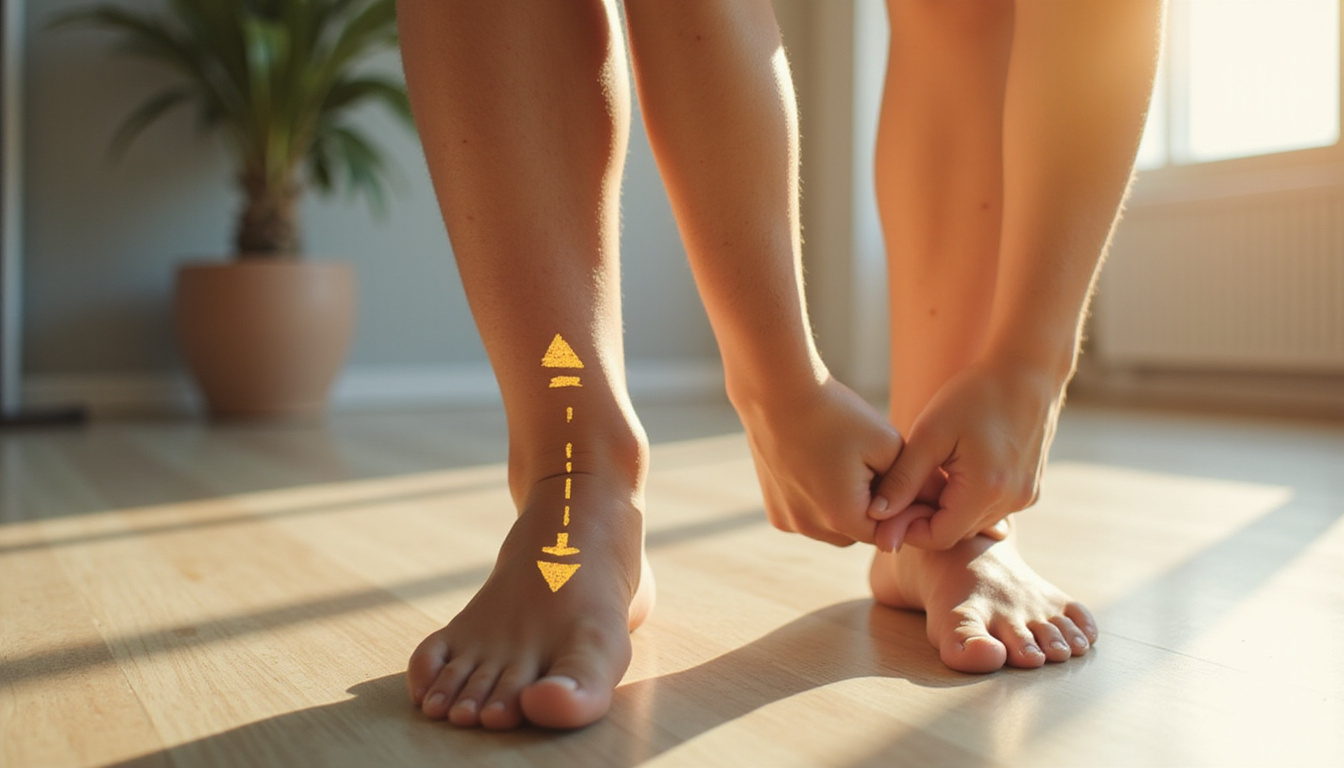
5. Single-leg balance (to stop the ankle from rolling again)
Balance and proprioception (sense of position) training is key for good ankle physiotherapy.
It is one of the main reasons people avoid repeated sprains.
Basic version:
- Stand with a wall or chair nearby for safety.
- Lift your sound foot and balance on your injured leg.
- Aim for 30 seconds; do 2–3 rounds.
- When it feels easier, try closing your eyes or turning your head side to side.
Progressions (under professional guidance):
- Balance on a cushion or foam pad.
- Do mini-squats on one leg.
- Catch and throw a ball while standing on the recovering leg.
How to know if your home exercises are working
You should see gradual improvements over 2–4 weeks:
- There is less stiffness in the morning.
- Your ankle stops giving way or feeling wobbly on uneven ground.
- You can walk faster or further before the ankle aches.
- You feel more confident on stairs and curbs.
If you are diligent with exercises and after 3–4 weeks your ankle still:
- Swells easily,
- Gives sharp pain on turning, or
- Feels weak like jelly,
it is time to have it properly assessed.
Why many Singaporeans choose a specialized pain treatment center
For persistent ankle issues—especially after multiple sprains or active sports—the simple advice to “rest, ice, and wear a guard” is often not enough.
The Pain Relief Practice is a well-established physiotherapy clinic in Singapore, serving patients since 2007.
We are a specialized pain treatment center for those who want:
- An accurate diagnosis of problems with ligaments, tendons, cartilage, joints, nerves, or alignment.
- Targeted treatment that goes beyond basic exercises.
- Performance-focused rehab for runners, sport athletes, dancers, or anyone who wants to move confidently.
- Prevention strategies to avoid repeated sprains.
We have treated celebrities and national athletes who rely on strong ankles to perform on court, field, stage, and screen.
The same principles that help them can be adapted to your life—whether you walk briskly in the park, chase your kids, or stand and walk for long hours at work.
Real Results
Celebrities & National Athletes
What to expect at an ankle physiotherapy session
A proper session at The Pain Relief Practice usually includes:
-
A Detailed Assessment
- We ask about your injury history, footwear, sports, and work demands.
- We test your ligaments, tendons, and joint mobility by hand.
- We analyze your gait and balance.
- We check your hip, knee, and foot alignment (often the hidden culprit).
-
Evidence-Based Treatments
Depending on your condition, you may receive:- Manual therapy and joint mobilisations to restore movement.
- Soft tissue release for tight calf, peroneal, and plantar fascia muscles.
- Targeted strengthening and balance drills.
- Movement correction and sports-specific drills if you are active.
-
A Clear Home Plan
You will learn:- Which exercises to do, how often, and when to progress.
- What daily habits to adjust: footwear, posture when standing, and warm-ups.
- Which warning signs to watch for.
Our goal is not only to relieve pain but also to help you regain healthy joints and muscles, boost your performance, and enjoy life without the worry that your ankle will give way again.
Practical Tips for Daily Life with a Sensitive Ankle
Along with your ankle physio exercises, these small changes help protect your joint:
- Choose shoes with good heel support and cushioning. Do not use worn-out soles that tilt to one side.
- Avoid long walks in unsupportive slippers or very high heels, especially soon after an injury.
- Warm up your ankle with gentle pumps and circles before sports or long walks.
- If you often roll your ankle, consider a supportive brace in the short term while you build strength and balance (your physio can advise on the type).
When to Seek Professional Ankle Physiotherapy in Singapore
Consider booking an assessment at The Pain Relief Practice if:
- You have had more than one ankle sprain on the same side.
- Your ankle still feels unstable or weak more than 3–4 weeks after the injury.
- Pain or swelling keeps coming back after walking, running, or sports.
- You feel stuck at a plateau despite doing your home exercises.
- You are a serious hobby athlete or professional who needs an ankle that can handle high demands.
Early help often means a shorter recovery time and less chance of long-term joint wear.
Our Google Profile
Learn more about us, see our location, and read patient reviews on our Google profile below:
https://share.google/UwMU2I9zUCwXVh0Lg
FAQ on Ankle Physiotherapy in Singapore
-
How long does ankle physio take to work?
For a mild to moderate sprain, many people feel clear improvement in 2–4 weeks with consistent physiotherapy.
More severe or repeated sprains may take 6–12 weeks of structured rehab.
The goal is to restore full strength, movement, and balance so your ankle stops giving way. -
Do I really need physiotherapy for an ankle sprain, or will it heal on its own?
Some mild strains may settle with rest.
However, without proper rehab, your ankle may remain weak or unstable, and you may keep re-spraining it.
Physiotherapy helps your ligaments, muscles, and balance system recover properly, reducing future injury risk and joint problems. -
What’s the difference between ankle physio and doing YouTube exercises?
Generic videos cannot account for your injury severity, foot type, gait, or sport.
A trained physiotherapist can pinpoint the affected structures, tailor exercises to your healing stage, correct your form, and guide your progress safely.
This is especially important if you are active, have had repeated sprains, or need a quick and confident return to activity.
If your ankle has been bothering you for weeks or you keep rolling it on steps or uneven ground, you do not have to live with it.
Targeted ankle physiotherapy at a specialized pain clinic like The Pain Relief Practice can help you stabilise your joint, rebuild strength, and get you confidently moving on your feet again.
We are a specialized physio treatment center for savvy people who want real results.
While we are not suitable for someone looking for ‘cheap physiotherapy’ or ‘free exercises available on youtube’, our treatments are affordable and are often claimable with company flexi-benefits, company health insurance, travel insurance, personal accident insurance, and other insurance plans.
Simply whatsapp or call: +65 97821601 and let us know how to help.
If you prefer a convenient nutritional preventive option, Regenerix Gold is our top recommended joint supplement.
We have been recommending this joint supplement for over a decade.
Simply start with 3 capsules, once a day.
If you do not feel better within a week, increase to 2 capsules, twice a day. (4 capsules a day in total)
Our blog readers qualify for a special discount.
Simply use the link below and a discount will automatically be applied during checkout.