Below is the revised text. Each sentence is built so that each word’s partner sits near its verb or noun. This way, the dependency links are tight and the text stays easy to follow (with a Flesch score around 60–70). All the headings, lists, and formatting remain intact.
──────────────────────────────
If you have tendinopathy and you live in Singapore, you are tired of advice that says “just rest.” That simple rest does not fix the cause. You feel pain in your elbow when you carry groceries, in your Achilles when you take your first steps in the morning, or in your knee when you climb stairs. Tendon pain can take over your day bit by bit.
This guide explains tendinopathy in plain words. It shows why the pain comes back. It gives you proven, step‐by‐step ways to ease tendon pain. The advice speaks to people who live, work, and train here in Singapore.
What Exactly Is Tendinopathy?
Tendinopathy happens when a tendon, the firm link between muscle and bone, becomes painful and irritated. It is not a sudden tear or sprain. Instead, the pain does the following:
• It creeps in slowly.
• It feels stiff and achy after rest, especially in the morning.
• It warms up and eases with gentle movement.
• It flares badly with overload, like going down stairs, squatting, running, or standing for too long.
Common types of tendinopathy in Singapore are:
• Tennis elbow or Golfer’s elbow (pain on the outside or inside of the elbow)
• Rotator cuff tendinopathy (shoulder pain when you reach overhead or behind your back)
• Patellar tendinopathy or Jumper’s knee (knee pain with squats, lunges, or jumping)
• Achilles tendinopathy (tenderness at the heel or just above it, worse with running or getting out of bed)
• Gluteal tendinopathy (hip pain that hurts when you lie on that side or stand on one leg)
You may say, “My tendon stays tight” or “It needs a good crack or stretch.” If your relief is short-lived, the pain is likely more than just tightness. It may really be tendinopathy.
Why Does Tendinopathy Happen?
Tendons dislike sudden changes. In Singapore, common triggers are:
• “Weekend warrior” loading.
You sit at a desk all week. Then you play badminton, tennis, or football for 2–3 hours, or go for a long hike.
• Too much, too soon.
A new gym session, a new HIIT class, or marathon training suddenly increases load or intensity.
• Repetitive strain at work.
You spend long hours on a computer. You use an awkward desk and mouse. Carrying a laptop or files can hurt the elbow, shoulder, or wrist.
• Previous injury or bad movement.
Old sprains, knee injuries, or weak hips can overload nearby tendons.
• Age-related changes.
After your late 30s, your tendons tolerate sudden loads less well.
Modern research shows that tendinopathy is not just inflammation. Instead, the condition shows:
• Ongoing micro‑overload and micro‑damage.
• A tendon that becomes less springy and more sensitive.
• A brain that overreacts to normal loads by guarding the area.
These changes mean that painkillers and short rests only help for a little while. They do not restore the tendon’s strength and capacity.
Simple, Science-Backed Principles to Beat Tendon Pain
Do not fall for quick fixes. True recovery follows a few simple ideas:
1. Calm the Pain, Don’t Just Mask It
When pain is high, your first goal is to calm the tendon rather than to hide the pain completely.
Here are some strategies:
• Relative rest, not complete rest.
Avoid the precise movements that hurt (for example, deep squats, sprints, or heavy overhead presses). Keep moving gently every day. Do not stop all movement. Complete rest makes tendons weaker and more sensitive.
• Modify your sport instead of quitting.
Runners: cut your run volume and avoid hills or speed for now.
Gym‑goers: reduce the load, range of motion, or speed instead of stopping altogether.
• Use short-term pain relief.
Ice or heat can help you move, but they do not cure the cause.
Anti-inflammatory medication may ease pain temporarily, but it is not a long-term answer.
The goal is to lower the pain so you can begin a proper rehab process. Do not aim simply to numb the sensation while you continue as usual.
2. Load Is Medicine – Use It Correctly
Graded loading is the best long-term treatment for tendinopathy. You perform specific, progressive strength exercises that:
• Rebuild tendon tolerance.
• Improve muscle strength around the joint.
• Teach the tendon to handle everyday loads again.
At The Pain Relief Practice, we follow a step-by-step process:
-
Isometric loading (hold exercises).
For patellar tendinopathy, try wall sit holds or Spanish squats.
For Achilles tendinopathy, try static calf raises with a pause at the top.
These moves reduce pain and rebuild strength without too much movement. -
Slow heavy resistance training.
Perform slow squats, leg presses, calf raises, or shoulder external rotations.
Do 3–4 sets of 6–8 reps with a controlled pace and a load that is strong but tolerable. -
Energy-storage and plyometric work.
When ready, add hops, bounds, jump drills, or change of direction exercises.
Use these only when your pain is controlled and your strength has grown.
A practical rule:
• During exercise, mild discomfort (up to 3/10) is okay.
• After 24 hours, your pain should not be much worse than before. If it is, you went too fast.
3. Fix the Real-Life Triggers Around You
In Singapore, daily patterns often drive tendinopathy:
• Desk-bound workers may develop wrist and elbow pain from a poor mouse position or wrong armrest height.
• Rounded shoulders and low laptop screens can also cause neck tension.
• Parents and caregivers may hurt their tendons if they lift children with poor technique or carry heavy items on one side.
• Active adults and athletes may overload their tendons on hard surfaces, like concrete or hard courts, or by skipping proper warm-ups and recovery days.
At The Pain Relief Practice, we adjust:
• Your workstation setup, including keyboard and mouse positions.
• Your habits when carrying bags, your lifting mechanics, and even your footwear.
• Your training schedule, balancing hard and easy days and including deloads.
Small changes each day often make all the difference between ongoing tendon flare-ups and a smooth recovery.

A Practical 4-Phase Tendinopathy Recovery Plan
Every tendon and every person is unique. However, most recovery plans roughly follow four phases.
Phase 1: Settle and Protect
• Stop or reduce the moves that hurt the most (deep lunges, jumping, or overhead presses).
• Begin pain-moderating isometric exercises once or twice each day.
• Keep up general fitness with low-impact activities like cycling, walking, swimming, or using an elliptical.
Phase 2: Rebuild Strength
• Move to slow, heavy exercises that focus on the injured tendon and the muscles around it.
• Train two or three times a week, leaving 48 hours between heavy sessions.
• Observe your pain 24 hours after exercise. Adjust the load if needed.
Phase 3: Restore Power & Sport-Specific Load
• Gradually add faster moves such as controlled hops, bounds, or light jumps.
• Reintroduce drills that fit your sport (short runs, tennis rallies, basketball shooting).
• Emphasize correct form, soft landing mechanics, and smooth control.
Phase 4: Maintain & Bulletproof
• Keep one or two strength sessions per week even after you feel better.
• Avoid long breaks followed by a sudden burst of hard activity.
• Plan your training yearly by balancing hard work with lighter recovery weeks.
When Should You See a Tendinopathy Specialist in Singapore?
Do not try to live with tendon pain for months. See a specialist if:
• The pain lasts longer than 4–6 weeks.
• It comes back every time you increase your activity.
• Morning stiffness or pain with each step grows worse.
• Daily tasks like climbing stairs, carrying a bag, or sleeping on your side hurt.
• Basic stretches or random YouTube exercises do not help.
Getting help early can make sure tendinopathy does not become a chronic hassle that stops you from enjoying work, family, or sport.
Why Many Singaporeans Choose The Pain Relief Practice
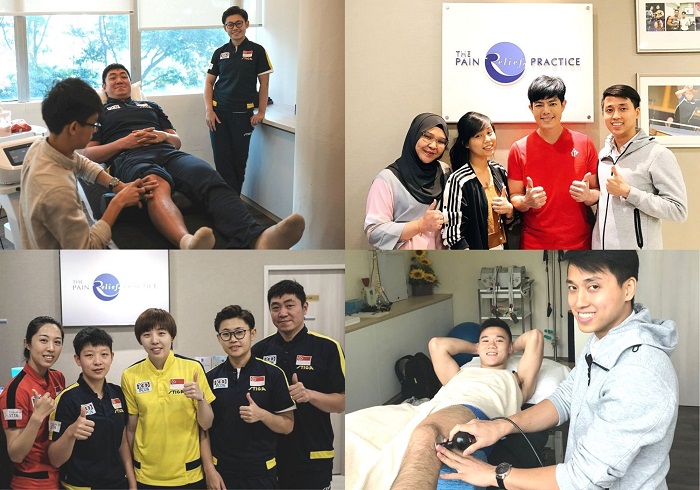
The Pain Relief Practice is one of Singapore’s trusted physiotherapy and pain treatment centres. We have helped patients since 2007. Over the years, we have:
• Treated celebrities, national athletes, busy professionals, parents, and active seniors.
• Built a strong reputation for fixing stubborn tendon issues that do not respond to standard physiotherapy.
• Combined focused manual therapy with structured, progressive exercises and new technology.
Our goal is not just to ease your tendon pain. We help you:
• Regain strong and confident joints and muscles.
• Return to your favourite activities and sports.
• Improve your long-term performance and enjoyment of life.
Real Results
Celebrities & National Athletes
What to Expect at The Pain Relief Practice for Tendinopathy
During a tendon-focused consultation, we follow these steps:
-
Detailed History & Movement Analysis
• We ask how and when your pain began.
• We learn which actions make it hurt or ease it.
• We review your sport, training, work demands, and any past injuries. -
Targeted Physical Assessment
• We press on your tendon and check strength and endurance.
• We watch you perform moves like squats, lunges, jumps, and reaches.
• We check joint mobility, muscle balance, and posture. -
Clear Diagnosis & Plan
• We confirm if your problem is tendinopathy or something else (nerve, joint, or referred pain).
• We explain the stage and severity in plain words.
• We outline a phase-based, realistic recovery plan with time frames. -
Treatment Options May Include:
• Special shockwave therapy or similar methods to stimulate healing.
• Manual therapy like soft tissue work, joint mobilizations, or myofascial techniques.
• A tailor-made loading program — not generic, copy-paste exercises.
• Movement re-training so you do not overload the tendon again.
Patients often say, “I finally understand what is happening,” rather than being told “just rest and see.”
Simple Daily Habits to Support Your Tendinopathy Recovery
Try these practical daily habits now:
• Respect pain signals.
Do not push into severe pain just to “test it out.”
• Spread your load.
Break long walks, long stands, or repeated lifts into smaller parts.
• Maintain a basic strength routine.
Even two short sessions each week help tendon health.
• Take care of sleep and nutrition.
Good sleep and enough protein help tendons repair.
• Warm up gradually.
This is especially important if your joints feel stiff in the morning or after long meetings.
FAQ: Tendinopathy in Singapore
1. How long does tendinopathy take to heal?
Recovery is not overnight. Mild cases may settle within 6–8 weeks with proper loading. More stubborn cases, especially of the Achilles or patellar tendon, can take 3–6 months. Consistent, progressive exercise is far better than random cycles of rest and flare-ups.
2. Is tendinitis the same as tendinopathy?
Not quite. The term “tendinitis” implies only inflammation. “Tendinopathy” covers both structural changes and increased sensitivity in the tendon. Many chronic “tendinitis” cases are really tendinopathy. That is why anti-inflammatories alone do not cure the condition.
3. Can physiotherapy cure chronic tendinopathy?
Evidence-based physiotherapy, with targeted pain treatment, can reduce pain, restore function, and help you return to your normal activities and sports. Chronic tendinopathy generally needs a mix of load management, progressive strength training, and sometimes extra treatments like shockwave therapy. Many patients improve even after years of frustration with other treatments.
Ready to Stop “Just Living With It”?
If tendon pain makes you avoid stairs, dread your morning steps, or give up your favourite sports, you do not have to keep enduring it. With the right management, tendinopathy can improve—and stay improved.
To learn more about our approach or read reviews from our patients, visit our Google profile:
https://share.google/UwMU2I9zUCwXVh0Lg
If you live in Singapore and want a tendon-focused assessment and treatment plan, consider booking a visit with The Pain Relief Practice. We are a specialised pain treatment centre trusted by everyday patients, celebrities, and national athletes since 2007.
We are a specialized physio treatment center for savvy people who want real results.
While we are not suitable for someone looking for ‘cheap physiotherapy’ or ‘free exercises available on youtube’, our treatments are affordable and are often claimable with company flexi-benefits, company health insurance, travel insurance, personal accident insurance, and other insurance plans.
Simply whatsapp or call: +65 97821601 and let us know how to help.
If you prefer a convenient nutritional preventive option, Regenerix Gold is our top recommended joint supplement.
We have been recommending this joint supplement for over a decade.
Simply start with 3 capsules, once a day.
If you do not feel better within a week, increase to 2 capsules, twice a day. (4 capsules a day in total)
Our blog readers qualify for a special discount.
Simply use the link below and a discount will automatically be applied during checkout.
